Part I: October 30, 2026
Around this time last year I saw an Instagram post from a Scottish witch.
Her name is Geo, and she’s known online as @thatglasgowwitch – a witchfluencer, if you will. She shares folk practices and soulful, magical energy with her following, and she’s building community around those practices.
But I didn’t know any of this then. I just paused on her reel because I loved her accent.
There is a side of me that’s always been a little bit witchy, and in that particular season I was looking for signs from the universe that might point me in a direction. I was waffling about where I wanted to go professionally, caught between where my heart was being pulled and what was actually going to sustain me and my family. My problem has never been a scarcity of ideas, but rather an overabundance of them that sometimes borders on mania. When that fire hose feels overwhelming, I look for the breadcrumbs – the signals that the universe is sending me. I’ve always done that to find my path and, by and large, it’s served me well.
Geo dropped me a fascinating breadcrumb that day. She offered up the practice of “13 Magical Nights,” or 13 Nights, as my shorthand goes. It’s described as a quiet ritual that bridges the old year with the new.
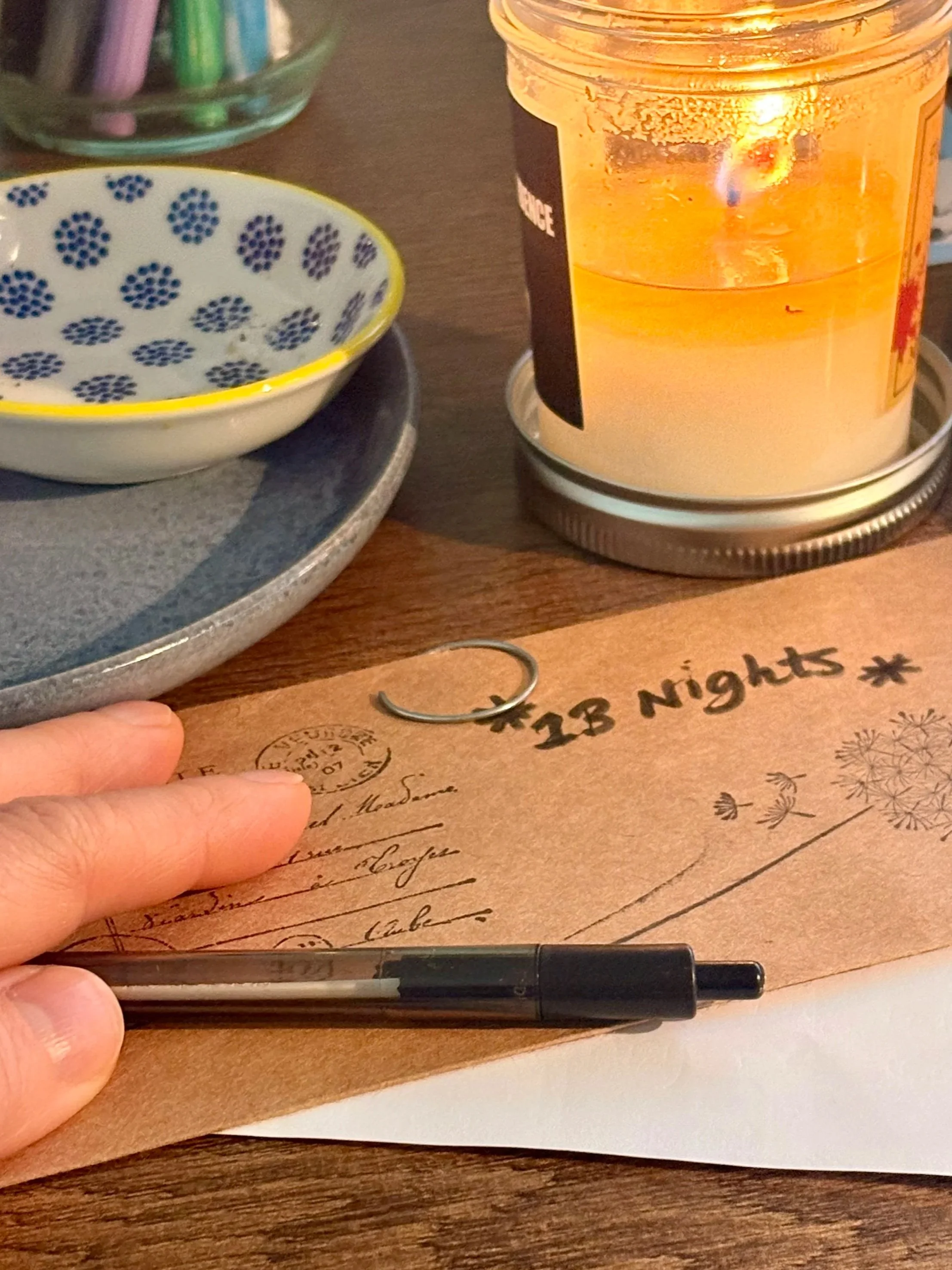
13 Nights is based on the German and Celtic tradition of Rauhnächte, when “you burn your wishes for the new year while the veil between this world and that of our ancestors is thinnest, and their influence the strongest,” as explained in this helpful summary. You start it on Halloween and complete it by New Year’s, in these basic steps:
Starting on October 31st and continuing until the winter solstice, write down 13 things you’d like to see happen in the following year. Don’t write them down as “I wish,” “I want,” or “I’d like to,” but rather “I have” or “I am”. You might do one or two a week, making sure they feel true and meaningful to you. When you’re done writing one down, fold it and hold onto it, ideally collecting them all in a vessel of your choice.
Then, each night beginning on the solstice (generally December 21st-23rd depending on where you are) and through the new year (January 1st), you’ll burn one of your folded statements in a candle without reading it first. “The act of burning releases it to my guides, to the universe, to whatever pattern of life carries it forward,” as Geo says.
On January 2nd, you unfold and read your last remaining piece of paper. It’s the “resolution” you must make happen yourself – the future self you must move toward. The others will be taken care of in their own time, and by their own influences, if they are meant to be resolved at all.
I saved Geo’s video and came back to it a couple of times over a week or so. The idea of the 13 Nights stuck with me for a few reasons.
For one, it strikes a balance between creating a direction for yourself, and surrendering to the universe. After all, you’re envisioning for yourself; it’s you creating the pieces of paper. And, mercifully for my popcorn brain, it doesn’t ask me to distill my thoughts into 1-2 ideas – I get 13 of them, but I have to choose my words carefully because who knows which one the universe will select for me. They should all hold relatively equal weight but also be distinct.
While I love exercises of reflection, I’d also been struggling with the idea of resolutions for a while. In recent years I’d been selecting a “word of the year” in January – something that could be my touchstone and wasn’t a complicated, unrealistic list of goals that would sit untouched in my journal. But I had no process or practice around selecting that word, or acting upon it, and so it had little effect. This ritual asks you to imagine 13 possible versions of yourself in the near future, and it reflects back to you a choice you’ve kind of already made. Because all of them are right.
And I was drawn to the ceremony of it – Halloween, the solstice, and New Year’s all contain seasonal moments and traditions that resonate with me, for different reasons, and this practice involves all three. But on a very basic level – tactile paper writing, candle burning, folky vibes, and a clear set of easy rules? This is my kind of sandbox.
So, I did it. And it was fun.
I filled out my slips of paper and stowed them in a thick, decorated envelope. Starting on the solstice, I followed the directions and even managed to burn my pieces of paper after sundown while we traveled between Christmas and New Year’s. Sneaking out of bed after my family was asleep (wherever we were staying) and finding outdoor corners in which to conduct my weird little ceremony felt like both a personal mission and a private game. Mostly I kept this experiment to myself because I didn’t want to explain it, nor did I want to have to share the result.
Did I have visions that I was favoring, that I was hoping would be selected for me? I did. Were those the ones that were selected? They were not.
After all of that, I had butterflies as I slowly revealed the chosen paper on January 2nd of this year, like I was unwrapping a chocolate bar to see if I’d won a golden ticket…
I HAVE FOUND A HOME IN MY COMMUNITY.
That’s what it said.
Huh.
So, I spent the next few weeks thinking about what that really meant, looking for more breadcrumbs, more clues for how to actually embody this. The community that I had been referring to when I wrote that was my geographic community – my fellow district citizens, the people in my surrounding zip codes. I hadn’t felt a complete sense of belonging since moving here four years prior, and that had begun to create a restlessness under my skin.
In this paradoxical age of both hyperconnectivity and epic loneliness, community can mean so many things, and it’s a word that’s been overplayed. I have tight-knit communities of dear friends and family, but none lives around the corner. I was in mourning for a work family that I had lost, and I felt disconnected from the national theatre community that I’d been embedded in; those communities were more ephemeral than I’d realized, at least in relationship to my life.
I was yearning for a village closer to home.
Breadcrumb. Let’s think back to what was happening in this country in January of this year as I mulled this over. Zohran Mamdani was sworn in as mayor of New York City after a history-making election powered largely by local organizers. ICE activity in Minneapolis led to the high-profile murders of two civilians, which in turn sparked a united outcry that rippled through communities across the states. In other words, national political tensions were playing out vividly and dangerously in communities, and communities were adapting into grassroots local response networks and fighting back.
Breadcrumb. Let’s also think about another non-American cultural framework that we talk a lot about in January – not Celtic, but Chinese. Specifically, the Chinese Zodiac, which was all over the algorithms of middle-aged women everywhere for some reason. This was the Year of the Fire Horse, following the Year of the Snake. Most of the writing around the year’s predictions focused on the “fire” part of the animal; the fire horse is marked by intensity and upheaval, and a need to counterbalance that heat with grounded steadiness. The animals, though? Snakes are solitary creatures, whereas horses move in herds (though the fire horse also conjures independence). Another way to see this: this would be a year of fierce banding together after a year of isolated rebirth. That astrological transition weirdly mirrored the state of my life, and I wasn’t alone; I’d been talking with more and more people around me who had been feeling the same way. We’d been quietly going through some sh*t, but we were coming out the other side, and ready to build community around our shared experiences.
I began to think that my 13th slip of paper was onto something: maybe 2026 was shaping up to be a year of intentionally connecting with the humans around us – the year of community.
After feeling for so long that the chaotic forces of our national politics, the tsunami of COVID, and the terrifying speed of technological change had been pulling us away from each other, there is a cosmic counterbalancing coming about. So many of us are carving out our place in our community in a much more intentional way this year. This has been dubbed “the year of analog” online, but the analog activities – screen-free events, dance parties and raves designed for women in midlife, surges in book clubs and local festivals and mutual aid networks – are all in service of building community where those local IRL connections have been fractured.
For me? I heeded the call of my 13th night and leaned into my immediate community. Here’s what this has looked like in practice:
I worked as a group guide with an organization whose mission is to connect women to other women around them and spark IRL friendships, facilitating group activities and conversations;
Via a neighbor I barely knew, I joined a local group of women (really just an informal email list) who meet up regularly in my town;
I worked with activists in my area on community organizing projects that serve overwhelmed parents and seniors, like time banking and play cafes;
I’ve been going with friends to those 6pm dance parties geared toward the 40+ crowd (and loving it);
I’ve been leading new cultural projects with smaller organizations, like a community-based arts summer camp near me, and an inaugural NYC summit at the intersection of music and health (that I’ll talk more about soon);
Above all – I finally started my own local business, literally helping people in my community find peace in their surroundings and build systems to manage the relentlessness of modern living;
That business has morphed into a multifaceted service, including helping elders in my community move through late life transitions.
Mind you, it’s not like I’ve done all of these things all year – I’ve been throwing them at the wall to see what sticks. And after years of working on large-scale projects that spanned the country, at an organization that served a field on a global scale – and after living outside the city for years, not knowing where I belonged – being on the ground has felt good. Being in people’s homes and working with them in their most vulnerable spaces, and being with kids who make art with their hands and voices and bodies, and being in living rooms and libraries and pubs talking through complex social transitions and grassroots movement building and community art projects – it’s been more than rejuvenating. It’s given me back some hope.
Part II: November 8, 2026
It turns out that hope was not misplaced.
Our communities have spoken. It could not be clearer now that the Fire Horse of change and resilience has reared up and dropkicked those who sought to divide us. Squarely. In. The. Balls.
I started this piece pre-midterms, pre-bluenami, thinking about what might be coming and trying to articulate a growing sense that we humans might be finding our way back to each other. Any lingering doubt I had that this was true has been blown away like dandelion seeds.
I also started 13 Nights again this year, on Halloween night. I’ve only written two of my 13 visions, and I’m buzzing with ideas for 11 more. Now that the new political landscape has been unveiled, the act of conjuring potential versions of my next year is so much more freeing.
Dream work is harder when we’re busy being torn apart.
I think that’s kind of the point of fascism, no? A Welsh politician named Aneurin Bevan once said:
"Fascism is not in itself a new order of society. It is the future refusing to be born."
Commentary throughout history has described authoritarianism as a state of paralysis between an old, dying system and a future that is not allowed to unfold.
If any of us have been feeling stuck for the last few years, maybe this is why.
Throughout this year, I’ve had to open myself to new experiences and meet new people to train myself to think about what else is possible. You can’t exercise those muscles while doomscrolling in a void is a waste; it requires risk and vulnerability. I guess that’s what I’ve learned: for me (and maybe for a lot of us, given the campaigns of community repair that just swept the nation), our most hopeful future lives at the crossroads of connection and imagination.
We’re not out of the woods, though, friends. A crack of light has appeared, and the end of the dark road is visible. But we still have communities voting against wealth taxes and trans people, even as they otherwise vote for change. We’re still learning how to imagine what could be possible for everyone, beyond ourselves and our next door neighbors.
I don’t know if this year’s 13 Nights exercise will yield such a prescient and cosmically aligned result. But there’s something to be said for giving a little of yourself over to the universe in moments of stagnancy. For a planner like me, this is easier said than done; but when we do it – when we allow the future and our fellow citizens to surprise us – that’s when the beauty of the world is truly allowed to reveal itself.
