Nonprofit Arts Are Social Impact. Why Don’t We Say That?
This article was originally published on November 25, 2025 on LinkedIn.
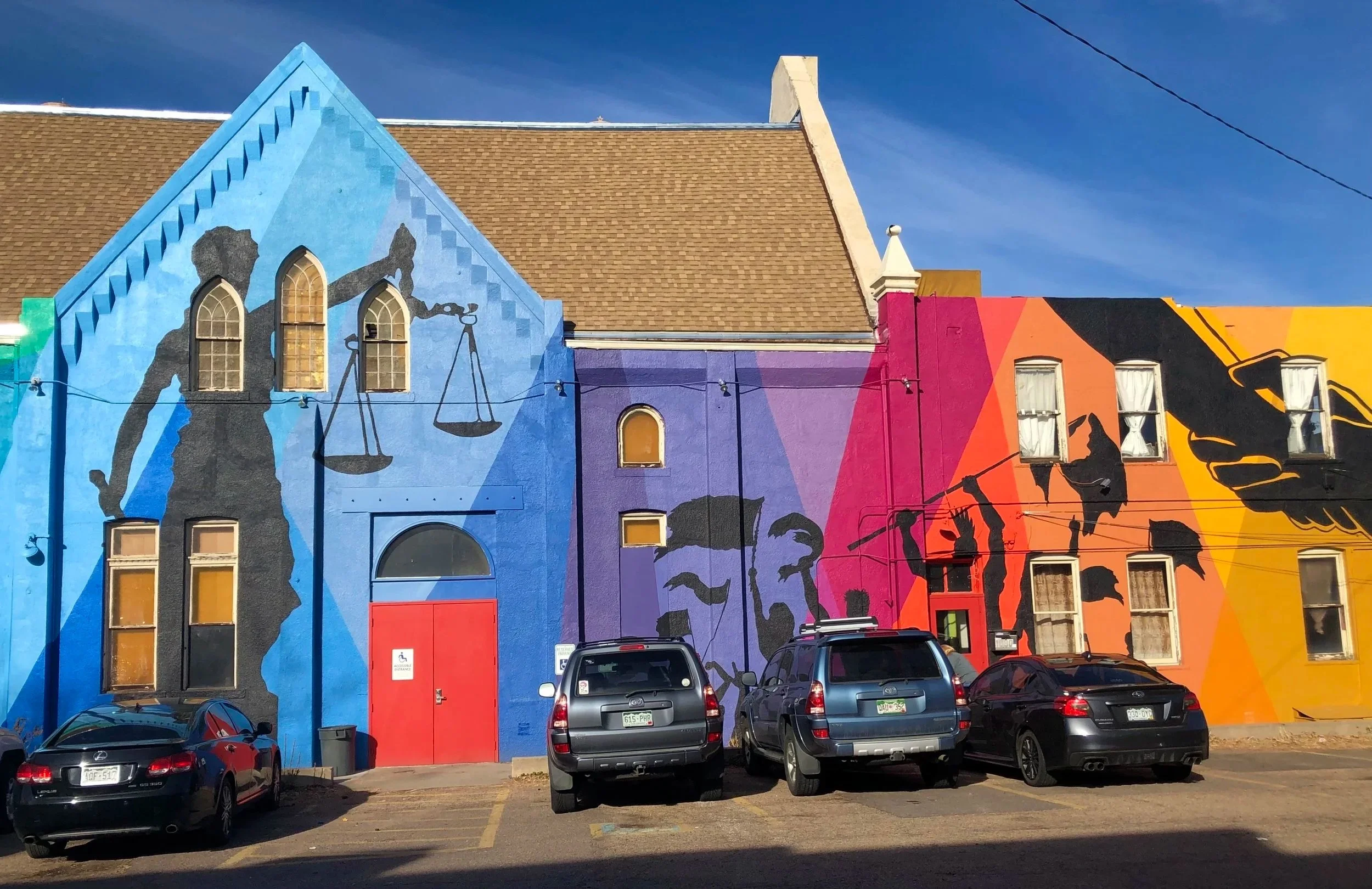
South side of the Curious Theater Company's building in Denver, CO, painted by Carlos Frésquez & his students in 2018. Photo by me.
I’ve noticed something over the years in my LinkedIn circles. As more people transition into “social impact” roles, or announce certificates (including me, from the Center for Social Impact Strategy), or take on new positions in philanthropy, climate, community development, education, or any of the many worthy domains under that big, generous umbrella—the term “social impact” gets used (and overused) constantly. It’s used as a kind of shorthand for “I’m doing work that matters, and I’d like you to know that.”
“Social impact” is used to describe such work as: programs improving maternal health outcomes, campaigns supporting democracy, clean energy innovations, and hunger relief initiatives. All good things. All crucial.
But here’s the pattern I can’t stop noticing: When people say “social impact,” especially in professional forums, they are almost never talking about art.
They’re not talking about the thousands of nonprofit theatres, museums, community arts centers, dance companies, music education projects, cultural service groups, and creative youth development programs that exist in every corner of this country, and across the globe. They’re not talking about the arts nonprofits fostering belonging for young people, healing collective trauma, creating jobs, rebuilding neighborhoods, convening people across divides, telling the forgotten stories, and doing it all with budgets that would make most well-funded impact orgs break into hives.
And they’re definitely not talking about the reality that the arts are one of more accessible on-ramps to civic engagement. Ask any kid who joined a community theatre production and suddenly discovered people that accepted and nurtured them. Ask any adult who found a local choir after a loss and found more catharsis in one evening than in months of therapy. Ask any immigrant artist who found her footing through a cultural space where her work mattered.
At this point I shouldn’t have to say it, but I will: Arts nonprofits are social impact organizations, and always have been.
Arts practitioners know this. We talk about it all the time. The fact that the broader “social impact” community continues to omit them—intentionally or unintentionally—is a problem. And it’s a problem worth examining, because it’s shaping funding, policy, professional pipelines, and the public imagination about what “impact” even is.
Why are the arts being overlooked?
I have a theory, and it’s neither complicated nor original.
When people use the term “social impact,” they tend to picture issues that present as urgent. About Survival. The things that if we don’t address them soon, people will die.
Arts and culture, meanwhile, get categorized as Enrichment. The things we can address after we’ve handled the “real issues.” When we’re stable again.
But that framing misunderstands the role of culture entirely. Culture shapes all those other issues. You can’t get to stability without a healthy arts ecosystem. Culture shapes identity, democracy, belonging, mental health, civic engagement, education outcomes, and social connection. The arts inform what we value, what we fear, what we imagine is possible.
The NEA, for all its limitations, used to know this, as did many national arts funders, who also funded many of these other issue areas, recognizing that they are intertwined with the cultural health of communities. I say this as someone who has spent 20+ years inside this ecosystem and in traditional social impact areas: in the urgency of this political moment, with the loss of high-profile cultural leaders from their posts and shifting funder priorities, more people are forgetting this again. The arts are not ornamental; they’re catalytic.
Whether or not the sector wants to admit it, arts nonprofits are doing social impact work every day—just without the branding.
The Metrics Problem
A big reason arts orgs get forgotten is that their impact doesn't always fit neatly into the metrics frameworks used in the social impact space. Social impact loves “KPIs” with clear lines: number of meals delivered, number of households served, % improvement in literacy outcomes, reduction in emissions.
Arts impact looks different. It moves in longer arcs. It’s qualitative, and personal. It’s about teenagers learning to express grief through writing, or a multigenerational audience seeing their neighborhood portrayed respectfully onstage for the first time.
The nuance of that impact doesn’t negate its realness. But what happens is that arts organizations everywhere are charged with figuring out how to convey through the language of social impact (data) what they mean to their community.
The solution is simple to name, and infinitely harder to put into practice: if measurement frameworks for social impact work were more expansive and less reductive, the arts might be easier to include.
Why This Matters Now
We are in a moment where the “social impact” space is more competitive than ever. Funders are realigning. Talent pipelines are evolving. Cross-sector collaborations are on the rise. Workforces are becoming multidisciplinary—artists working in policy, activists working inside arts orgs. And yet, the narrative keeps art in the margins.
When we talk about community resilience but leave out the cultural organizations embedded in the community, there’s a disconnect. When we talk about systems change but forget the role of storytelling and culture bearers in shifting systems, that doesn’t track. When “impact” becomes synonymous with survival and urgency and not longer time horizons of cultural change, that’s not just inaccurate—it’s destructive.
It’s leading to less funding, less visibility, fewer opportunities for entry, and fewer key leaders (especially young leaders, leaders of color, working parents, and people outside major cities) entering or staying in arts careers. I’m writing this as one of those leaders.
So, what do we do?
I’m not arguing that arts and culture should take space away from any other issue area. It’s not a zero-sum proposition.
I’m arguing for a broader, truer definition of social impact—one that recognizes cultural work as a legitimate driver of change.
A definition that sees Art as intrinsically tied to the default social impact issues, and a definition that allows arts nonprofits to sit at social impact tables as essential partners, not “the entertainment.” A definition that acknowledges that the work artists and cultural workers do often makes other forms of impact possible.
So, if you’re someone who works in an arts nonprofit: claim the identity of social impact. Organize with your fellow orgs and petition your funders. Leaders, provide your staff and artists professional development opportunities around this. If you’re someone who works in philanthropy, social innovation, or any of the big umbrella “social impact” fields—or you hire or recruit in those fields: widen the frame.
If you’re someone who straddles both worlds, as many of us do: help build the bridge. The social impact sector is stronger and more relevant when it reflects the full landscape of what actually sustains communities.
Art has always been part of that landscape, so let’s talk about it that way.
